“What’s the Matter?”
by Nancy Seidler
Professor, Humanities and Media Studies, Pratt Institute
At a time when facts rest on quicksand, truth, meaning, language fall to the wayside. What can be said to rehabilitate a sense of order? To restore faith that words matter? This was the zeitgeist at the spawning of the first wave of surrealism, and it is so today. In our current reality, what still holds? What remains when meaning slips and certainty falters? This moment mirrors another — the chaotic dawn of surrealism — when the first wave of artists turned to dreams not to escape reality, but to confront its limits. In the exhibition, Surrealism Tomorrow: The Next 100 Years, Pratt students reveal what it means to be a young artist through their material engagement with ideas forged in Andre Breton’s Manifesto of Surrealism just over a century ago.
In waking life, we narrate our world, ourselves, with words. Our internal thoughts, our interactions with others, our understanding of daily events, these things ride on the underpinnings of language. Words are how we tell the stories of ourselves to ourselves. Several artists in the exhibition come from other cultural and linguistic backgrounds, and are immersed in a sea of language full of rip tides, threatening to pull even native English speakers under. I will focus on their work here.
Highlighting the strengths that multilinguals bring to the project of surrealism at this moment is not arbitrary. Being a stranger in a strange land lends to one’s experience a sense of estrangement, Viktor Schklovsky’s magic ingredient for making and understanding art. Making strange, leaving coherence behind, moving into a world of leaps of the imagination, dreams, yearnings, this is what non-native artists floss their teeth on. Estrangement is their strength. Their tongues split and re-form across languages, across media. Their bodies navigate the fractures of identity in a globalized, unstable now. They dwell in the in-between — and from that liminality, they create.
Schklovsky wrote mainly about imagery as it exists in poetry. Steven G. Kellman notes that translingual writers are better equipped than monolinguals to step outside the realm of their first language and to “make us aware of the factitiousness of verbal constructions (114).” By extension, multilingual artists may have an inherently suspicious regard for English, for the notion that we say the things the way we do because that’s the way they are. They see the world from a different vantage point, and position themselves in a liminal space. Charlotte Burck argues that “The hazards of being positioned between languages and the experience of the limits of language and representation therefore encompass possibilities for creativity (26-27).” Potential limits that language places on all of us, no matter our linguistic home, become a generative source for these artists in particular.
These artists create meaning through material practice, though the rules of the discourse are unbounded by grammar, syntax, fixed vocabularies. Their works roam a different territory, they make meaning through matter. Their practices open a door to the liminal space where surreal imaginings might stir. However, they are not outside of language. Karan Barad, the post-humanist physicist, looks at matter like this:
Matter, like meaning, is not an individually articulated or static entity… Matter is not a linguistic construction, but a discursive production in the posthumanist sense that
discursive practices are themselves material (re)configurings of the world through which the determination of boundaries, properties, and meanings is differentially enacted (pp. 150-151).Karen Barad
Material practices are in wordless, though discursive relation to linguistic practices. Anything beyond this would push toward the irreal, something outside of the realm of our understanding. The pieces in this exhibition made matter meaningful through their conversation with each other, and with translatory force.
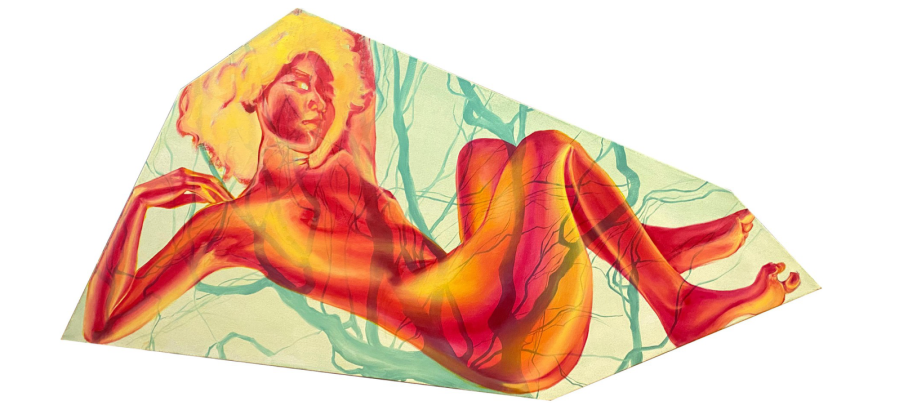
Danninger Feng’s work, ‘An Irregular Dream 1,’ strikes with lightning heat. A large piece, with a languid figure lounging in a polygonal cell, an angular womb, a weird pod, hovers in neon splendor. While the figure burns with intensity and acid fire, she rests in a cool plasma fed by green veins. Dreams speak the logic of images. Structures of coherence that bind words together break down here, and we drift in a sea fed by our wakeful experiences. When that sea itself is turbid, what might filter through? Feng’s project heightens this ambiguity as it seeks to “underscore[] both the struggles against external limitations and the power of self-definition.” She presents a dream of liberation from “societal and cultural frameworks that seek to confine and define femininity.” Her girl, bound in the geometry of gender definitions, is literally pushing the boundaries.
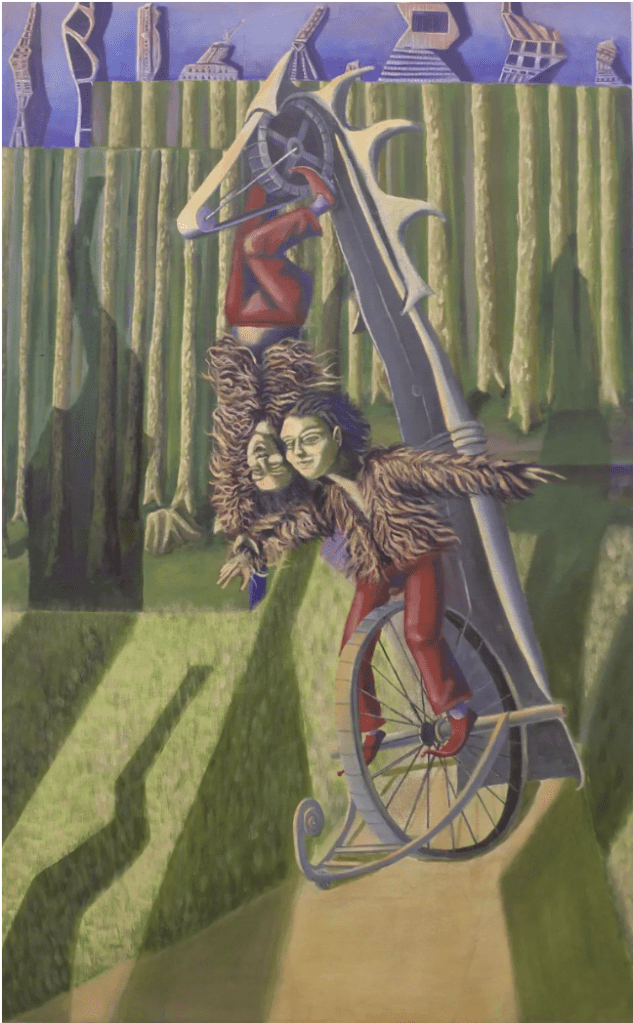
Shan Yu’s ‘Faking and Making’ offers an equally subversive view of not only the role gender plays in our daily life, but of the interconnectedness between the role of women and nature in contemporary cosmopolitan realities. In her painting, two smiling, seemingly identical twins ride upon a vertical cycle, one figure balanced on the shoulders of the other. They ride through a manufactured park, synthetic and dull. Trees and grass mimic nature, but fail to capture its vivid and fulsome beauty; trees are mere trunks cut off before branches appear, grass is cut precisely, but without a hint of lifeforce. Buildings appear beyond the trees, though those too are discomforting and off balance. But the most off putting and powerful element is the faces of the two impossibly balanced figures, forced into smiling? grimacing? Masks. In a joyless world, happiness becomes compulsory, but Yu’s world reveals its artifice.
Both of these artists located their work within the framework of an aesthetics of resistance. They resist linguistic categorizations and constructions of gender, nature, self, and build a dreamlike world in which play, joy, and power burst forth. It’s no wonder that when language fails, artists rely on material practice to fill the epistemological gaps. How might we come to know ourselves and our worlds differently? These two want to show you how.
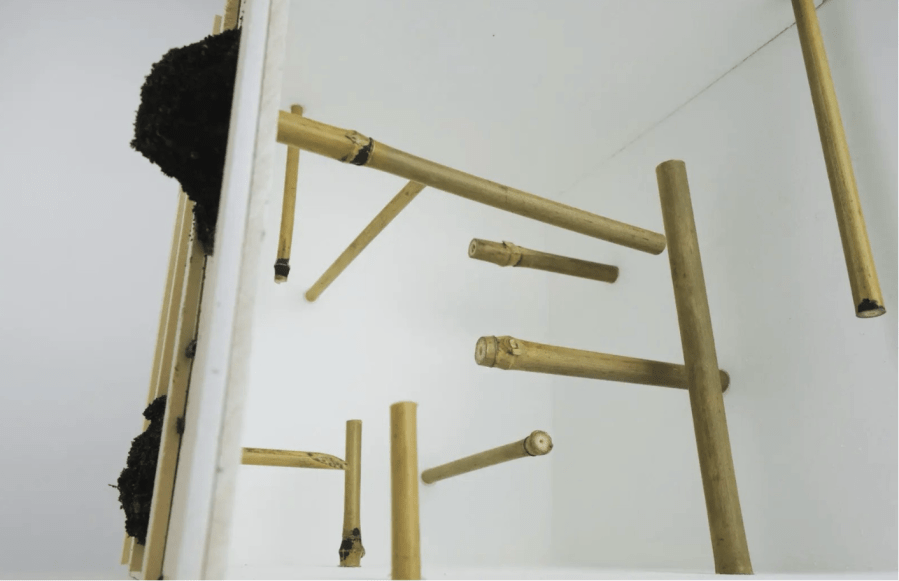
And then there’s Six Sides, Two Worlds, No Truth… by Ian Chen and Evan Wu — perhaps the exhibition’s most direct attack on the idea that truth can be captured at all. They arrive dressed as scientists, but the lab coats are a ruse. The box they invite us into is a space of failure — failure of function, of logic, of symmetry. The bamboo poles fall short. The math refuses to resolve. The room offers nothing but presence — and even that feels unstable. What’s outside cannot explain what’s inside. And maybe that’s the point.
In line with first-wave surrealists, these artists bring the uncanny, the dreamlike, and the warped to not only make sense of our contemporary conundrums, they push against the boundaries of what seems possible in their material practice. We are not in a moment of coherence. These artists don’t seek to stitch meaning together — they let it unravel. What arises instead are leaps of intuition, visceral collisions, impossible hybrids. They traverse a psychic landscape where grammar has no dominion. Their work matters.
Works Cited
Barad, Karen M. Meeting the Universe Halfway: Quantum Physics and the Entanglement of Matter and Meaning. Durham, N.C: Duke University Press, 2007.
Burck, C. Multilingual Living: Explorations of Language and Subjectivity. Palgrave, 2011
Kellman, Steven G. Does Literary Translingualism Matter? Reflections on the Translingual and Isolingual Text. Dibur Literary Journal, Issue 7, Fall 2019
 losing our grip on purpose