By Erin Kroncke
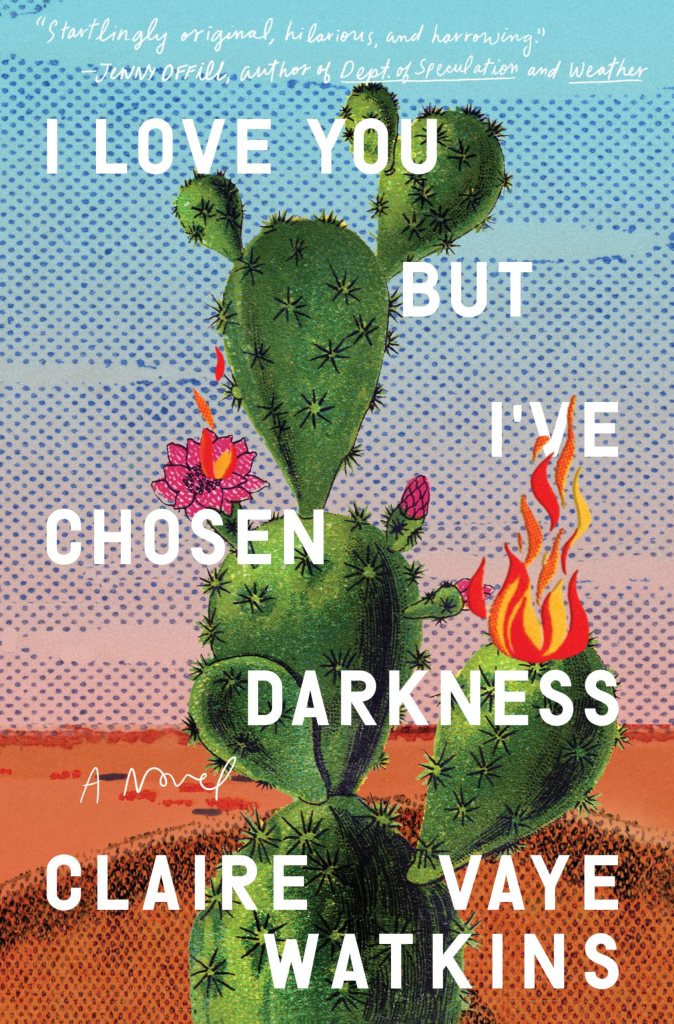
The harsh desert environment births the feminist grit of I Love You but I’ve Chosen Darkness as we follow Claire Vaye Watkins as she adapts to the cruel conditions of her upbringing and generational trauma. This auto-fiction taps into the complicated feelings that emerge from trauma, and in this stylistic choice, both the reader and the narrator navigate difficult topics that blunted text may otherwise be unable to capture. With its vagina dentata bearing down the feminine teeth of coming into one’s power as blatantly flawed and mercilessly unapologetic. Whether you agree with Watkins’s approach to life or not, she has masterfully disempowered the societal expectations for mothers everywhere.
The tones of feminism are ever present within Watkins’s classic motherly plight, ramped up to the highest degree. She rejects the norms of society and how mothers should take upon them the entire lot of the homestead. In doing so, a shift in narrative happens and we see an unusual concept that we aren’t accustomed to. The man is left behind with the baby and is essentially a victim to her selfish needs for freedom from the mundane. Our protagonist is messy and oftentimes careless, yet the narration continually forgives her for her mistakes, avoiding the common accusatory language that often stalks women for the slightest mistakes. Yet here we are, entwined with a flawed woman whose womanhood is simultaneously not acknowledged, while also at the forefront of her journey.
Watkins’s choice to maintain Claire’s autonomy begs to question our expectations for how mothers and women are viewed within our own thought processes. She is not the best mother; she is also not a terrible parent. She reaches baseline decency in the family dynamic; most mothers can attest that their husbands hardly lift a finger when it comes to domestic responsibly. Claire’s husband exemplifies the nurturing, responsible parent that is oftentimes attributed to women, stemming from the societal belief that it is a feminine trait. The promise of commitment to family life disintegrates when Claire departs, and why not let it be.
Claire is a selfish character and intentionally so. She is unabashedly a fuck-up when it comes to her personal relationships. She is portrayed in a way that so many men stumbling through stories before her have in crisis, and unsure of how to regain their virility. Our protagonist has her own virility, and she seeks to satisfy her sexual urges, even though she has slight concern for her ferocious vaginal cavity and those who dare to enter it. She leaves her family completely in the dust. Her husband deals with the consequences of domestic life and he does just that. The other side to this feminist concept is the allowance of the man to be soft and to credit his nurturing capabilities. Since the child is safe with dad at home, we are able to go out on these adventures with Claire and play witness a woman’s self-discovery. “Mom Life” isn’t for every woman and why should it be? Her lack of maternal instincts indicates that maybe women aren’t programmed to be the sole caregiver, maybe it isn’t nature, but Claire’s lack of nurture in her own life, that thrust this societal expectation deep in the metal trash heap behind the trailer.
Touching on the text’s historical note, the protagonist’s father is deeply immersed in American true crime history as Charles Manson’s wingman and lurer of young girls. We get snippets of his own book My Life with Charles Manson as the narrator summarizes her father’s text, that–mind you–is hard to come by and when you do. Her father died when she was a young girl. Claire learns of her lineage through his book and interviews, sharing them with us with longing. Illustrating that both connection and confusion can exist within the same moments, we accept her lineage alongside her. Knowing that such a sordid history is where she comes from elicits pride and mythos, which makes way for the reader to feel compassion for a descendant of such a heady connection.
Claire’s own mother grew up poor, and missed out on the life she wanted. As a writer herself, the reader sympathizes, helped along by the letters she wrote as a young girl that divulged her innocent desires. Her mother is the crux of the majority of Claire’s own issues, but why must we demonize her for her flawed existence? She shares the joy of such an adventurous, curious mother as much as she does for the addiction that plagued her life, that brought so much pain to her daughters. We can see the patterns in a sensitive way and come to terms with the fact that for Claire, the urge to mother cannot be mustered.
Claire wants to feel pleasure, and her postpartum depression accentuates this. As a child, she immerses herself in her successes by excelling in school and seeking external validation, but really, it’s just the next dopamine hit. She pursues what will drown out the boring, what might overwhelm a life. She’s unreliable, and she takes excessively from her husband without a thought for his feelings. As women, we’re oftentimes forced to navigate the world in ways that make us small in order to be heard. Claire gives no thought to adapting to society’s expectations. It begs the question: can we be as forgiving to mothers who seek a different way of life as we are to fathers who so often escape the eyes of judgement?

Erin Kroncke is a writer/artist in Los Angeles, California. Her work has been published in Inscape Magazine, The Courier, The Closed Eye Open and Quillkeepers Press to name a few. Her short films have been featured in The Topanga Film Festival, Planet 9 Film Festival and others. She lives in Los Angeles with her family.
 losing our grip on purpose