What have you been up to these last couple of months? Share freely any publication news you may have, and please include any links you’d like us to include.
I have been focusing on abandoned manuscripts I accumulated over the past eleven years. I have faced a lot of self-doubt over the course of my creative and academic career. I let my creative pursuits be derailed a few times because of disruptions in life such as mental health, financial constraints, physical health issues, and becoming a stepmother.
After separating from my husband, I was forced to face the dread feeling of persisting even when it was not asked for–even when my creativity was looked down upon as inessential. I had to confront the fact I didn’t want to be a housewife, that somewhere along the way I got a bit lost, and I let other people convince me of who I should be. My own husband told me my writing career didn’t matter because it didn’t make any money. However, once I started writing again, I felt a return to myself, and I pushed myself toward my goals, albeit with wrenches twirling inside my stomach the whole time.
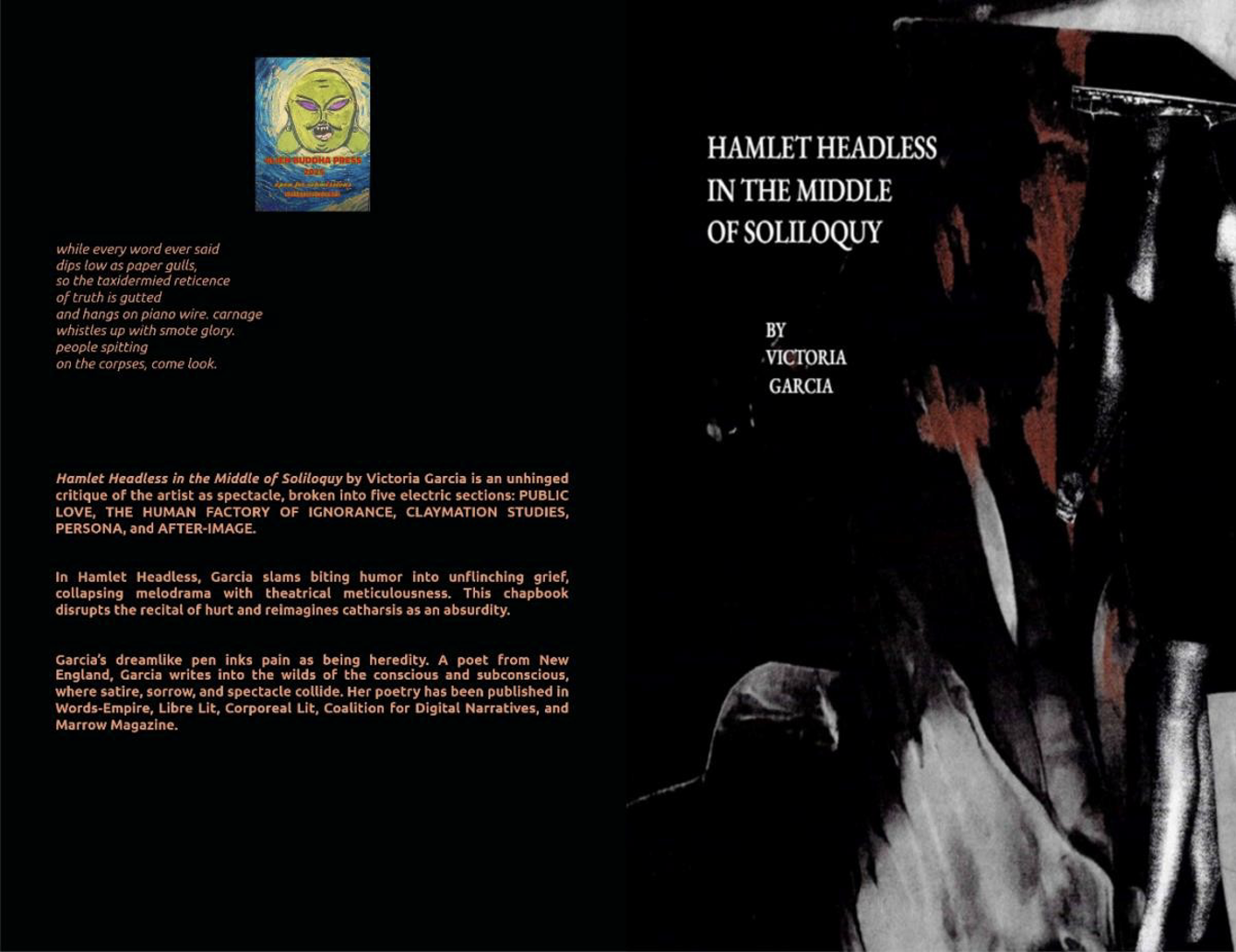
I actually have a poetry chapbook Hamlet Headless in the Middle of Soliloquy forthcoming in Alien Buddha Press August 4th of this year. Hamlet Headless in the Middle of Soliloquy is a chapbook that subverts the performance of pain, and reimagines catharsis as embodied absurdity. It follows a performance artist through an arc of releasing intimate pain beyond cashed-in vulnerability. The collection confronts how the pursuit of catharsis can disrupt personal intimacy, and the meta-tension of marketing pain for public love.
You can find a link to a short reading of the collection on Alien Budda Press’ Alien BuddhaTube playlist here:
You can also find the preview of the cover below:
I have been incredibly honored to have some poems published by small presses such as Corporeal Lit, The Coalition for Digital Narratives, and Marrow Magazine. Corporeal Lit featured three of my poems: “no more run-on anthems of anatomy;” “funerals are all part of the body;” and “if anyone understood the role of words are visceral.” In their ninth digital edition, The Coalition featured three of my poems “colossally wrapped;” “empty heaven of heaven;” and the “winter of eulalia” for their issue on themes of “manufactured foreboding, cosmic nightmares, and the cosmically pedestrian.” My poem “the only way to have an affair is to tell each other nothing’s happening” won an honorary mention in Marrow Magazine’s 2025 Anti-Valentine’s day contest Rotten. My very first publication “Call on the Vanishing” was published in a small Nigerian journal Words-Empire.
You can find the hyperlinks to my past publications here: Corporeal Lit, The Coalition, Marrow Magazine, and Words-Empire.
Whether you read my work or not, you should check out these lit journals and the other content they have curated. Now is a really important time to support small presses. They are incredibly important to the literary community. Personally, I find a lot more groundbreaking work in small presses these days.
I mostly publish my work on social media. If you want to find my work unfiltered and in-progress, you can find me on
TikTok: (@etherealram)
Bluesky: (@phantom.lamb.bsky)
Cease and Caesura Lit: (@ceaseandcaesura.bsky.social.)
What are your long-term creative plans? Are you working on something big and secret or taking it day by day?
One specific long-term creative plan I have put into action is reviving my literary blog Cease and Caesura. I had to shut it down temporarily. Mostly, because I was overwhelmed with physical health issues, mental health issues, and personal issues. I needed a new model for self-care, creating, and productivity. I also went through a rebrand on Wix without much success. I had to move across several platforms, and I was not satisfied with my rebrand after switching to Blogger. However, I am happy to say that Substack is up and running.
You can find our post on a genre-defying poem about generational trauma by Susan Evans here: “The Claustrophobia of Wounds”.
You can also find our past post on meditative poetry by Jon Summers in the hyperlink here: “Contributors’ Corner: Jon Summers”.
For some background, Cease and Caesura Lit is a literary Substack featuring poetry, hybridity, flash fiction, creative nonfiction, and literary reviews. The literary Substack was born out of the desire to house unconventional writing that did not find its way into mainstream publishing. I wanted a place to house the obscure, the absurd, the lonely, and the misunderstood. Cease and Caesura Lit’s main goal is to provide electric and genre-defying literature.
In the future, I would like Cease and Caesura to gain a large enough audience to evolve into a physical press or quarterly journal.
Another long-term creative goal I have is to get back into book arts and bookbinding. It was a craft I pursued in college, and I loved the physical act of creating books. Getting back into book arts is woven into the ambition I have of running a literary press.
I have been trying to get back into drawing as well. I consider myself more of an outsider artist because I abandoned drawing after failing as an illustration major in college.
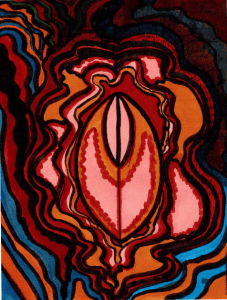
In terms of the manuscripts I have been working on, below is a preview of a cover for a larger collection I am working on The Modern Nun.
The Modern Nun explores themes of confronting religious trauma, regaining autonomy, rediscovering personal agency, and coping with the aftermath of divorce.
An excerpt from The Modern Nun that confronts the disempowering dynamics of domestic femininity:
eve
i am offered a fruit.
i’m offered the beginning of time.
i am offered the position
as someone’s wife
and led gallow to gallow.
Two other collections I am working on are I Am Ether and Come Down From. I Am Ether is an exploration of the complicated and elusive problem of the shifting BPD self, and it is still in its rough draft stage.
Come Down From is a poetry collection that excavates pseudo-intellectualism, belief as dialectic, and grammar as heartbreak. Likewise, it establishes broken syntax as thought pattern; voice; and embodiment of chronic illness. It operates in lineage with Gertrude Stein’s poetics, but it complicates Stein’s vision for language-as-visual-art by pursuing the experimental as embodied meaning.
What’s the status of your mental health these days? It’s in all ways prosaic to say that we live in trying times. How is the zeitgeist responsible? What are some actionable ways in which you’re taking steps to quiet the void, if any? (If it’s a glass of wine and an episode of Mad Men at the day’s end, that counts, please know that).
As of late, the abuse of religious systems in American politics has been detrimental, and has caused my nervous system to catch fire. However, it has pushed me to uncover dormant parts of myself I was much more ambivalent towards—parts I left buried. The aggressive political climate has been a persistent shove toward awakening.
In terms of my mental health journey, I have been in and out of therapy since 2020. I struggle with Borderline Personality Disorder, Depression, and Anxiety, which I found out in therapy after my first relationship ended at the start of my senior year of college.
Breakups are difficult for anyone. However, for someone who has BPD, abandonment is a core wound of the disorder, so a breakup triggers a soul gutting agony that feels like witnessing the death of a loved one. It can be debilitating when you feel like you need a death doula to guide you through a breakup.
People with BPD feel emotions deeper and for a longer duration of time than people who don’t have the disorder. It isn’t that the emotions of people with BPD are more important than those who don’t have the disorder. The problem is how the intensity and depth of the emotion leads to dysfunction. Breakups aren’t only emotionally turbulent for an individual with BPD, they derail the individual’s life and re-open stored trauma. That being said, I am talking about the reality of the feelings and experience of the individual suffering from the disorder. As someone who has significant relationship trauma, I want to stress that I don’t believe in staying in a relationship solely because you feel guilty for leaving.
For those who are not familiar with BPD, it is a highly stigmatized and misunderstood cluster B personality disorder characterized by severe emotional dysregulation. BPD is usually shaped by trauma, especially emotional abuse, and the symptoms are aggravated by interpersonal triggers. I am also looking into whether or not I have Complex Post Traumatic Disorder (C-PTSD), which is not considered an official diagnosis in the DSM-5 but is still recognized.
With BPD, the mind wants to simplify triggering emotional or interpersonal stressors by categorizing events or situations neatly into black and white boxes. The contradiction is that the mind cannot effectively sustain either perspective. It takes flight into opposing ideas, and doesn’t make a stable landing in any clean categories. This is a psychological defense mechanism called splitting. People with BPD struggle to hold two contradicting thoughts at once while triggered, so the brain tries to protect itself by cutting opposing perceptions clean in half. The dilemma is this defense mechanism only leads to further destabilization, which is what makes it an ineffective and maladaptive coping mechanism.
Much of managing BPD involves unlearning maladaptive coping mechanisms as well as deeply rooted negative self beliefs (or negative cognitions), which is why Dialectic Behavioral Therapy (DBT) is designed to help establish effective coping mechanisms through mindfulness practices.
A mindfulness practice I still use from DBT is going outside in the cold in winter when I get really upset. A change in temperature helps to return your attention from your emotions and back to your physical body.
Other actionable ways I manage are by moving my body. I love running and taking long nature walks. When I am overstimulated, moving through nature is an act I can take to re-ground myself. When I was a teenager, my favorite time to run was during torrential downpours. My restless and clamorous mind was stilled by the pouring rain. Rain felt like an anchor that helped me stay connected to the material world in a healing way.
I have difficulty feeling grounded in my physical body. I am a lot more in tune with my mental and emotional body than my physical body. Unfortunately, this has a lot to do with my mental health, religious trauma, chronic physical illness, and relationship trauma, which perpetuate my desire to escape my physical and mental pain.
I believe creativity is separate from mental illness, and I dread depictions that glorify mental illness as a creative superpower. Because I create in spite of mental illness. Not because of it. However, in the past, I struggled with distinguishing the overlaps between mental illness and creativity, which have led me to escapist and dissociative tendencies in life and writing. For a long time, I had to fight to feel like a real person rather than apparition walking the long halls of simulation.
It is really easy to get disconnected from your physical body, and resist running headlong into escapism. For this reason, I have been trying to find small, comforting ways to feel rooted in my physical body again. These days, I feel less like I am slipping through the veil of one illusion after another.
What is something you’d like readers to take away from your work in regard to mental health advocacy, discussion, or criticism?
What I would like people to take away from my work is how mental health is more nuanced. As I was studying psychology in college this past semester, I learned psychologists sometimes leave boundaries blurred between comorbidities. Because there are no clear delineations between where one condition overlaps with another. Psychologists cannot always distinguish which overlapping symptoms belong to a particular condition, especially conditions where a specific symptomatic criterion is similar and belongs to both disorders.
While there are specific diagnostic criteria, you have to be able to step into someone’s experience and recognize that these things exist on a continuum. Often, there are shared symptoms and struggles among certain disorders, but no two experiences of a disorder are the same. When you are reading a neurodivergent writer’s work, it is important to consider that you are stepping into a variation of the disorder–not a rigid, linear set of symptoms. Likewise, you need to be careful about only consuming media about mental health disorders. Because that’s how stereotypes grow and fester. It is critical to stay informed and up to date on the current psychological literature.
Psychologists are confronting how psychological classification is necessary for organizing mental health disorders, but they are also acknowledging how it has the capacity to lead to over-simplifications that can create stigma with labels. A well-informed psychologist will tell you psychological labels are for diagnostic purposes only. Unfortunately, psychologists have also been guilty of perpetuating stereotypes, but people in the psychological field are working to correct this.
In the past, I used to feel betrayed by psychology because of how BPD was stigmatized. Many therapists still struggle to understand the disorder, and people in the mental health system still hold alienating biases of people with the disorder.
People with BPD are often typecast as the villains of the mental health system, and are stereotyped as manipulative, aggressive, and dramatic. For a long time, there was little progress in understanding BPD because people held onto outdated research of the disorder. As a result, ubiquitous success stories for BPD have been limited, and people with BPD still struggle to find the therapeutic help they need. Because they are the kind of patients therapists are most wary about working with.
I suppose that is why I always turned toward lyricism or indirect modes of language rather than narrative. Poetry that leans into voice rather than storytelling is a strong point for me. Because when I asked for help and was vulnerable, my narrative got written over by other people’s assumptions. In that sense, I didn’t feel like I had a narrative. In my work, I showcase the painful disorientation of perception I have experienced in my mental health journey, and I accomplish this through a lyrical set of imagistic ruptures and sonic dissonances.
Why do you create, still, despite the climate and political current and pervasive doubt we’re made slaves to?
I continue creating for a few reasons.
First, as a place of both private and public intimacy. I don’t do well with surface interactions, so reading other people’s work is how I connected with others on a more personal level. It is understandable people feel a bit naked in public when sharing intimate details, so I don’t blame people for not knowing how to navigate that level of intimacy. Social dynamics make it challenging and even dangerous for the authentic self to come out of its nesting doll. Vulnerability feels counterintuitive to survival, but it is essential to our humanity. I view my work and other people’s creative work as a way to bypass the surface self, and break into the intimate aspects of the self.
Second, as a mode of empathy and as a form of encouraging others to find their authenticity.
Writing is as much about raising up other people’s voices as it is cultivating your own voice. Unfortunately, there are a lot more systems in the world that lead to erasure than personal discovery.
Lastly, creating is a mode of reclamation. Much like Dickinson, writing and creating are an act of independence for me. It is where I hold onto my agency and autonomy. Unfortunately, America has worn the disguise of independence and progress for a long time, and it has done so under the beast of right wing politics. The result and outcome of this election confirmed some of my suspicions—progress has been used as more of a marketing scheme. People’s real-lived experiences and struggles have been extorted as a way to shadow progress rather than embody it. In a sense, this election showed me how America was crawling toward an illusion that had been slowly breaking down for years. The election was merely the final act of atomization. That is not to say that there have not been people genuinely pursuing progress. However, with the way the majority voted, it is an intimate betrayal that exposed a lot of people’s masks and real priorities about helping minorities and demolishing class systems.
After the terrible news of the election, my professor Ryan Flaherty reminded me to keep writing and creating—to keep returning to these creative acts. At first, I didn’t quite understand what he meant, or why he would give me that advice. But in a sense, he was saying creativity is a call to action, and a call to a preservation of self, identity, and independence.
Ironically, this should be the root of American politics. Even though it has not been successfully implemented, Americans still have a deep belly of brimstone within them that urges them to fight for their individuality. Trump has twisted that healthy sense of pride and independence into a narrative that portrays him as bold and outspoken. What he really is doing is twisting people into his knot of censorship and control, so writing and creativity remind me that I still belong to myself–that I have a true self a fascist system can’t control.
I am also closely related to Maria Innocentia Hummel–the nun who made figurines Hitler despised because the figurines portrayed German children in a way that Hitler was vehemently against. She kept creating these figurines of German children in the style she wanted, and even made money off of them in spite of Hitler’s attempts to censor and limit her creativity.
I can’t say she was revolutionary or progressive. She still toed the lines of religion and conservative values. However, it is an astonishing act that she persisted in creative independence during a time of extreme censorship and control of the arts. I think we all have that in us no matter who we are related to, but I have more confidence in honoring my creativity after learning more about her tenacity to maintain her own creative power and choice. I believe there is potential for myself and others to do the same. I believe humanity retains a quiet lineage of creative resistance, and we all have the power to tap into that creative resistance.
 losing our grip on purpose