Matti Ben-Lev
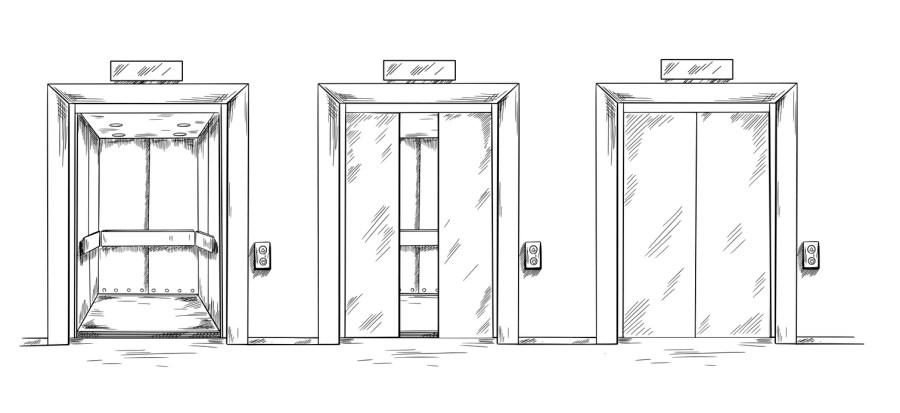
You’re waiting for an elevator.
A smooth leather briefcase with an amber-edged, carved handle resting in your palm, slick with sweat. An ironed, fitted blazer with matching slacks. A white collared shirt. Ruby red tie worn slightly too tight around your stiff neck.
ding
The elevator door opens, crammed with bodies. Solemn-faced crowd. You try to loosen your tie, but it tightens, its stiff cotton groping your neck like a splinter you can’t extract. Digging itself deeper. You’re asked which floor and you hear the words top floor come out without you deciding to say them. Without knowing what waits for you there.
ding
As the elevator passes each floor, your tie fastens, thickens against your throat. You poke an index finger beneath the smooth fabric, but the tie goes taut around it. Eventually, the tension pushes the finger out.
ding
The elevator arrives at the top floor. Your floor. Your shoulders are gripped by a blank face, dimmed as if erased, and you’re ushered into a boardroom, placed before a team of expressionless executives. Faces blurred like radio static, all wearing the same expensive, tailored suits—like yours but sharper, with blue ties. Your tie fastens, now pressing against your Adam’s apple, your breathing forced into shallow, measured breaths. The air in the boardroom is grey. Boardroom shaped like a rectangle, dotted with windows and auburn leather swivel chairs. They gaze up at you, stone-faced, impatient. Your hands twitch.
You’re at a podium now and you feel the weight shift in your palm and now the briefcase has been replaced with an ash grey clicker and a screen descends slowly at your back and now you can see, in your peripheral vision, your name glowing in white letters against a fluorescent blue backdrop and you’re supposed to be giving a presentation and you don’t know what you’re presenting because you never know what you’re supposed to be presenting because you never feel you’re where you’re supposed to be and your ruby tie presses into your throat like a boa constrictor strangling prey, pressing so tightly that—when you try to speak—soft hums trickle out and now the granite faces look irritated and impatient and suddenly you realize you have control.
You walk to the oval window closest to you, slide it open. Jump. The tie disappears as you fall, the sweet release of flight. You close your eyes. Hands tucked at your sides. Hands still. Hands preparing for impact.
This is the part where you’re supposed to wake up
Your eyes open in time to watch your body be swallowed by an oval hole in the gritty pavement, a slanted plexy glass hole that your body shatters through and you’re back in the boardroom now and the window is painted shut and the door is locked behind you and everyone in the room is angry, vicious, sharp-toothed, seething, hungry, and you still don’t know what you’re supposed to be presenting and you’re not waking up because you never get a say in when you wake up because nothing you’ve tried has ever worked.
Your red tie strangles you until you die and only then you wake up.
You never come to when you’re supposed to. Instead, you’ll spend years being woken by EMTs with flashlights, asking you to keep your head still and follow their harsh yellow light with your brown pupils and you’ll wake up to charcoal-powdered pumped stomachs with blood orange gashes and dusty blue stitches and you’ll wake up with slate straps stretching marks across torn skin and you’ll get woken up by sobbing parents and desperate partners. You’ll awaken again—another again—in a locked ward with windows nailed shut to keep you from jumping, locked wards like the first ward where you first have this dream. You’ll wake up and you’ll keep waking up until you finally tell someone the truth about the hurt, about why you keep taking the pills. Until you admit to the doctors it wasn’t an accident, until you listen to what they have to tell you.
You’ll spend years writing about this dream and questioning why you don’t remember any others.
And you will one day feel a waking—not a physical rousing, but an internal waking, a waking from the inside-out. Only after an awakening will you feel awake.

Matti Ben-Lev‘s work has been published (or is forthcoming) in The Rumpus, Grub Street, Ekphrastic Review, Corporeal, and elsewhere. Matti holds a BA from Towson University where he studied creative writing and served as a poetry editor for Grub Street, Towson’s literary magazine. He is currently an MFA candidate in nonfiction at George Mason University and a reader for the lit mags Phoebe and So to Speak.
 losing our grip on purpose